Category Archives: New Homes

Latest new home news and views from the New Home Expert

Bloor Homes – OTE Park, Burgess Hill

Over 20 years ago the Property Misdescriptions Act came into force. The aim was to stop properties being described in a more favourable light than the actual reality. The PMA has now been superceded by The Consumer Protection from Unfair Trading Regulations 2008 and the Business Protection from Misleading Marketing Regulations 2008.

Bloor Hamilton smallBloor describe their “Hamilton home as an “extremely spacious” (122 square metres – 1313 sqft) four bedroom home with “spacious lounge” (3.61m x 6.5m) with a master bedroom that “benefits from a fantastic en suite facilities and fitted wardrobes”.Wow! Bloor also state that there is “an additional storage cupboard on the landing” (probably the airing cupboard) and that “a garage and driveway are also included” Sign me up now!

The specification states “turfed front gardens”, but looking at the development plan, that is not a lot of turf! Nearly all the homes are virtually at the back of the footpath as is the case with most new homes built over the last 10 years.

As far as prices go a four bedroom “Hamilton” new home will set you back £399,950. Or as Bloor are keen to point out £319,960 with HelpToBuy, meaning you need to find just a £20,000 deposit and be able to afford payments on your £300,000 mortgage to own 80% of this home! A 25-year mortgage at 3% interest means you need to find a massive £1,436 a month, half of which is interest. So much for ‘Help to Buy’ Mr Osborne!

Share this:
Share this page via Email Share this page via Stumble Upon Share this page via Digg this Share this page via Facebook Share this page via Twitter

As the NHBC publish the 2013 Quality Award winners its another successful year for Barratt and a disaster for Persimmon Homes

The NHBC has just announced the winners of their 2013 Pride in the Job Quality Awards. From around 13,000 site managers, just 400 won Quality Awards, being short-listed to go forward to the next round, the Seal of Excellence awards. 

The NHBC’s Pride in the Job Awards has nowNHBC PIJOB been running for 32 years, and continues to recognise the UK’s best site managers, building better quality new homes on well-managed sites. The NHBC confirm that “a Pride in the Job award is the highest industry accolade a site manager can receive, most importantly, homeowners who buy a Pride in the Job award-winning home benefit from a high quality product” 

You would think that given the prestige and recognition of quality construction that every house builder would be actively striving to improve quality to win as many awards as they can. But you would be wrong. Unfortunately, year on year many of Britain’s largest house builders pay little more than lip-service to improving the quality of their product and this is reflected in the low number of NHBC Quality Awards they win each year. Our sister website, brand-newhomes.co.uk, publishes league tables for the awards every year, in addition to listing the number of homes each builder actually builds per Quality Award won. 

Whilst Barratt, which includes David Wilson Homes, over the last six years increased their share of awards every year, winning 96 Quality Awards in 2013 up 31% on their total last year, most of the other national listed house builders Taylor Wimpey excepted, win significantly few awards. Especially considering the number of sites they have and the total number of new homes they build each year. 

Whether it is housing boom or a period of recession would appear to have any effect as the number of awards won each year is mostly near the average over the last six years. 

However whilst most house builders win a similar percentage of the total awards to their percentage of the national total of new homes built last year, one house builder bucks the trend, Persimmon Homes. 

In 2013, Persimmon site managers won just nine NHBC Pride in the Job Quality Awards with a further four being won by subsidiary Charles Church. This represents just 3.2% of the total NHBC Quality Awards in 2013, from a company that built 8.5% of the nation’s new homes last year. Worse still, this years total is a massive fall of 38% on the meagre total of 21 Quality Awards Persimmon’s site managers won last year. 

You would think that new home buyers would be mindful of quality when deciding which builder to buy a new home from. However, despite their lack of Quality Awards, Persimmon have managed to increase the number of homes they sold, with profits up by 52% in 2012, due in part to a 6% uplift in the average selling price of their homes. 

To put this into perspective, new home buyers are nearly six times more likely to buy a Quality Award winning home from Barratt than they are from Persimmon. In addition Barratt have been rated 5 stars in the HBF customer satisfaction survey for the last four years, whereas Persimmon have only ever achieved a 4 star rating. 

With the new home industry ever keen to dispel the terrible reputation it has for building new homes riddled with preventable defects, it is surprising that these benchmarks of quality are not considered more by every prospective new home buyer. At the end of the day there is a choice and as the table below indicates you have a better chance of a quality buying a Barratt home than you do buying Persimmon, which may not have been the case ten years ago.

Housebuilder

Total homes built in 2012

Percentage of overall number

Number of quality awards 2013

Percentage of total awards

Average awards last 6 years

Number of new homes built per award

Barratt

12,637

11%

96

24%

70

131

Taylor Wimpey

10,886

9.4%

68

17%

51

160

Bellway

5,526

5%

27

7%

20

193

Redrow

2,458

2%

12

3%

11

204

Crest Nich.

1,882

1.6%

7

1.7%

10

269

Berkeley

3,712

3.2%

10

2.5%

8

371

Linden

3,039

2.6%

7

1.7%

4

506

Bovis

2,355

2%

4

1%

4

588

Persimmon

9,903

8.5%

13

3.2%

25

761

Share this:
Share this page via Email Share this page via Stumble Upon Share this page via Digg this Share this page via Facebook Share this page via Twitter

End Help-To-Buy ‘subsidies’ for house builders

 Time to end Help-To-Buy : The government’s state house builder subsidy.

It is a sad fact that homes remain unaffordable and it is difficult to get a mortgage unless you have managed to save a substantial deposit. “Help-To-Buy” the government’s “solution” is to subsidise the new home industry. 

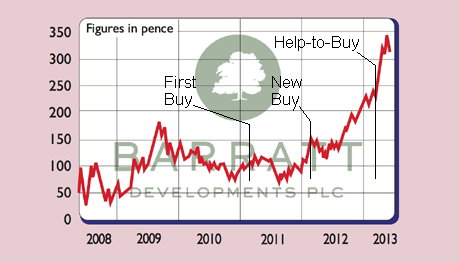
Since the first “state aid” for house builders ‘FirstBuy’ in March 2011, all the major house builders shares have soared, with many doubling in price and more! With the latest “incentive” ‘Help-To-Buy’ house builders do not even have to contribute anything, resulting in the biggest rise in their share prices since it became available in April 2013 (see the chart below.) 

Barratt Share Price 1

All three government schemes have helped house builders sell houses without having to reduce prices. This has resulted in a 50% plus increase in reported profits over the last year. As new home buyers now only have to find 80% of the price asked by house builders, many builders are actually increasing prices as the increased demand is not being matched by an increase in the number of new homes being built. Before the last property bubble burst in 2007, 200,000 new homes were built. The house builders currently estimate they will build just 110,000 this year, many on cheap land acquired during the last recession increasing profit margins even more. 

Any increase in interest rates would cause a major problem for anyone buying these over priced state subsidised new homes, as a big fall in house prices is likely. Indeed this, together with the Help-To-Buy mortgage underwriting scheme has all the hallmarks of a government-sponsored house price bubble. There is a correlation between interest rates and house prices. As interest rates go up, prices fall and vice-versa. Keeping interest rates at artificially low levels can only further inflate house prices. 

The Chancellor should impose a windfall tax on all house builders using Help-To-Buy on profits above 20% of turnover, with anything above being taxed at 80%. Failure to do so would leave many drawing the conclusion that costly government support for house builders and their wealthy shareholders, means we are most definitely not “all in it together” assuming we ever were!

Share this:
Share this page via Email Share this page via Stumble Upon Share this page via Digg this Share this page via Facebook Share this page via Twitter

The total of 115,620 new homes were built in 2012.

New Home Completions and dwelling stock figures for England released

The estimated number of residential homes in England produced by the Department for Communities and Local Government statistics were released on Thursday 25 April 2013. The figures show that the estimated number of dwellings in England increased by 0.59% on the previous year to 23.1 million. This is the lowest annual increase in any of the previous 10 years and demonstrating not enough new homes are being built. 

This is split into 19 million private dwellings (owner-occupied and private rented) and 4 million social rented homes. The Social rented stock rose by 12,000 between March 2011 and March 2012.

Total annual housing completions for 2012 were 115,620, an increase of 1% on the previous year. The current level of completions is still 35% below the December 2007 peak level of 177,000. New Home completions fell through 2008, 2009 and in the year to December 2010 just 107,000 new homes were completed.

In the 12 months to December 2012, the majority of new homes started were in Buckinghamshire, Bedfordshire, Cambridgeshire, and Northamptonshire, along the M5 corridor from Devon up to Worcestershire and along the A303 route from London through Hampshire into Wiltshire 

Despite falling over recent years the percentage of owner-occupied homes remains at 65%.

Share this:
Share this page via Email Share this page via Stumble Upon Share this page via Digg this Share this page via Facebook Share this page via Twitter

Leasehold homes are rapidly losing their value

Many are seeing the value of their new homes fall and this is not as a result of the property market!

Around a tenth of all owner-occupied homes are leasehold. That is 1.43million homes, 817,000 of which are flats. Leasehold is when the land on which the property is built is not sold with the home. All leasehold homes are only owned for the duration of the lease, after which the ownership reverts to the freeholder.

The maximum length for a lease is 999 years. But many new homes have been built with leases that are just 99 years. As owners soon discover, when a lease has less than 80 years left, the value of the home decreases. Properties lose around 5% of the value when a lease reaches the 80-year mark.

When the lease is 60 years or less, homes start to rapidly lose their value and become all but impossible to sell or re mortgage. Most lenders require at least 55 years left on the lease, with around 30 years left at the end of the mortgage term.  Many new homes sold in the 1980’s with 99-year leases may now only have 65 years remaining.

Leaseholders should look at extending their lease when it reaches 85 years. A lease can be extended by 50 years for a house and 90 years for flats. The 1993 Leasehold Reform Act made it possible for all leaseholders to extend their lease by up to 90 years and gives them to legal right to buy the freehold.

Continue reading

Share this:
Share this page via Email Share this page via Stumble Upon Share this page via Digg this Share this page via Facebook Share this page via Twitter

Five reasons why ‘Help-To-Buy’ is a bad idea

Five problems with the Help-To-Buy scheme.

1. It could create a house price bubble

The UK is not building sufficient new homes to meet demand. Instead of focusing policy on the supply side the government has taken steps to increase demand by making it easier for people who couldn’t and perhaps shouldn’t to get on the housing ladder.

It is basic economics that if demand increases without an increasing supply prices will rise as a consequence of the shortage.

Government policy should not be underwriting and subsidising another housing bubble. This policy is not making homes more affordable but will make them easier and more expensive to buy.

2. It could help the well-off buy a second home

The Treasury has published a list of those who would be eligible to benefit from the Mortgage Guarantee element of the Help to Buy scheme, which is available on properties up to £600,000.

This did not rule out people using the scheme to buy a second home- an issue still yet to be clarified by the Government. The scheme may even be used by existing owners to remortgage their property.

As it stands, unless the eligibility criteria is revised to rule out people exploiting the scheme it looks like Osborne is making it easier for the well off to get wealthier.

3. Government policy should focus on social housing

Most experts argue that the State should be focusing policies that increase the provision of social housing to help those most in need in our society, rather than attaching itself to the mortgage market and helping house builders by making it easier to buy a new home.

The government should not be encouraging mortgage providers to lend to borrowers that it would otherwise consider too risky.

We all know what happens next.

The Government funds allocated for social housing are small beer when compared to the scale of Help to Buy, which could potentially underwrite £130bn of home loans.

4. The taxpayer is exposed to huge losses

If Help-To-Buy starts price bubble in the housing market that then bursts, leading to a property price crash many borrowers “helped” to buy could default on their repayments and lenders being forced to repossess and sell.

If house prices fall with resultant losses, it will be the taxpayer picking up most of the liability.

5. It may not lead to cheaper mortgages

At present only the banks partly owned by the taxpayer, Lloyds Banking Group and Royal Bank of Scotland have agreed to use the Help to Buy Mortgage Guarantee Scheme. If the scheme is to be a success it will depend on the uptake by lenders and the extent to which they reduce their rates and fees prices to account for the Government underwriting loan guarantee.

At present current financial regulations force banks to hold over six times more capital against 95% loan as they do for a 60% loan. The regulator may be looking at offering banks some relief from the capital adequacy rules.
 

Share this:
Share this page via Email Share this page via Stumble Upon Share this page via Digg this Share this page via Facebook Share this page via Twitter

Why most UK home buyers would NOT buy a home built after 2003


Three-quarters of the British public would never buy a home built in the last 10 years.
That is the finding of a 2010 YouGov poll carried out on behalf of the RIBA as part of their study into the ever decreasing size of UK new homes, now on average 80% smaller than an equivalent European Union new home.
One in four home buyers would avoid any home built in the last 10 years.

There are many reasons given but overwhelmingly the most common is that new homes are just too small and too dark.
There are also many other Disadvantages.

The RIBA Case for Space study found that buyer’s priorities vary with 69% saying that a high level of natural light was important to them.
A further 51% confirmed that room size was the most important factor when looking to buy a home.
Outside space was important to 47%.
Privacy to 49% and the appeal and look of the street or estate being important to 43%

It is therefore no surprise that the following reasons were given why those surveyed in the Future Homes Commission’s Report (September 2011) would choose not to buy a new home:
* Lack of storage space
* Lack of privacy from neighbours
* Poor sound insulation
* Lack of outdoor space
* Not enough space in rooms
* Small windows/not enough natural light
* Inflexibility of spaces for communal and private living or for future changes in the

Share this:
Share this page via Email Share this page via Stumble Upon Share this page via Digg this Share this page via Facebook Share this page via Twitter