Category Archives: New Homes

Latest new home news and views from the New Home Expert

Why house builders will never build enough new homes

Why we need to start building council houses again.

It is not in house builder’s interests to build the 200,000 new homes required each year.  Not only would it use up their five-year landbank supply, it would also mean new house prices would fall as would house builder’s profits.  So house builders voluntarily building more homes for motives other than increasing their profits is about as likely as a turkey looking forward to Christmas!

It is also a fact that house builders do not have sufficient skilled labour and the necessary management skills to build a combined 200,000 every year, year in, and year out.  So if, as has been the case for the last 25 years, house builders continue to drip-feed new homes on to the market what is the solution?

Council house 3

Let’s start building decent council houses for decent people.

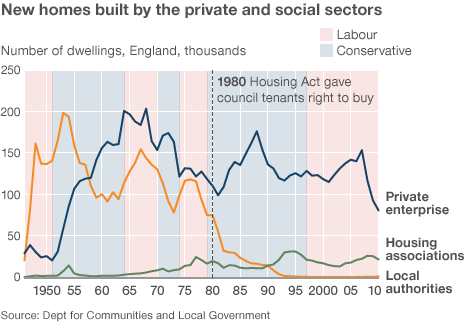
The answer lies in a return of publicly funded council house building on a national scale. Not with Housing Associations building more social housing just for those on benefits, but by allowing councils to use their cash surpluses, currently earning little if any interest, to build council houses on their own land. It worked well in the fifties and sixties; millions of council homes were built to replace so-called slum housing. But they were not classed as ‘social’ housing – in fact they were quite the opposite. They were homes for everyone – especially for workers on middle incomes. Getting a council house was based on how long people had been on the waiting list. There was no rationing and no stigma. They were new homes on estates with genuinely mixed communities. Good, well designed quality new homes with decent sized gardens for working families. Homes where people would want to live for most of their lives. But this golden age came to an end with the advent of Right to Buy and Housing Acts in the 1980’s which prescribed who could access social housing and who could not.

So now is the time to start building council houses again

Houses built since 1950A council house building programme could be partly funded with a surcharge of say £1,000 for every new home sold by every UK house builder.  The likes of Barratt, Persimmon and Taylor Wimpey would pay in around £37 million a year between them.  They could hardly complain given that the taxpayer-funded subsidy Help To Buy has increased their profits by over 50% and more during the last twelve months. This would not increase the price of new homes as builders always price  to the maximum the market can stand anyway,  price too high and they won’t sell!

Continue reading

Share this:
Share this page via Email Share this page via Stumble Upon Share this page via Digg this Share this page via Facebook Share this page via Twitter

Do the NHBC give Quality Awards only to site managers building high quality new homes?

The NHBC 2014 ‘Pride in the Job’ Quality Awards have recently been announced and it is clear that most of the major house builders have not improved the quality of the homes they build.  See the house builder league tables here for awards in 2014 and previous years.

OLYMPUS DIGITAL CAMERALast year Barratt made history with 102 of their site managers winning awards for quality. This year, despite building more homes on more sites, Barratt won 13 fewer awards – 89 in total, followed by Taylor Wimpey with 70 – just two more than last year!

The remainder of the largest house builders won just a handful of quality awards, much as they did last year – Linden 5, Bellway 29, Redrow 13, Crest 12, Bovis 4 and Berkeley 12. The biggest shock was again Persimmon, the largest house builder by market value, winning a pitiful 8, even less than the meagre 13 their site managers won in 2013!   Clearly this company has problems and appears to be indifferent to the quality of the homes it builds.

It is becoming an increasing concern that the NHBC hand out awards to certain builder’s site managers regardless of their personal management ability or the quality of homes built on their site.  TWPITJ1Last year, the NHBC gave Taylor Wimpey’s Richard Crawford a Quality Award for his site at The Chariots in Andover.  Since then, many unlucky homebuyers have discovered  their homes were not only poor quality, but in some cases also potentially dangerous, with various electrical faults despite passing an “inspection” and incorrectly wired boilers.  Taylor Wimpey 9 months small sizeOne buyer (full story here) has taken over 35 days off work to allow various trades access to his home to fix and repair the defective workmanship. So far (8 months on) CEO Peter Redfern has failed to get personally involved and has not even replied to the owner’s many detailed letters.   Yet this site manager won an NHBC Award for “Quality” for this site!

Continue reading

Share this:
Share this page via Email Share this page via Stumble Upon Share this page via Digg this Share this page via Facebook Share this page via Twitter

Another Government gift for the housebuilders!

Chancellor George Osborne announced an “urban planning revolution” to protect the greenbelt and promote house-building on brownfield sites in his annual Mansion House speech to the Corporation of the City of London.
Money

Even more taxpayer cash used to help housebuilders!

George Osborne said that £500m had been earmarked to accelerate urban house building through the planning system. The initiative will deliver 200,000 new homes by 2020 while also protecting the greenbelt.  He said:        “We need to see a lot more homes being built in Britain. The growing demand for housing has to be met by growing supply.      We’ve got the biggest programme of new social housing in a generation; we’re regenerating the worst of our housing estates; and we’ve got the first garden city for almost a century underway in Ebbsfleet. Now we need to do more, much more.”

In an attempt to appease the heartland of Conservative voters who are not keen on development of the countryside, Osborne added:   “We have beautiful landscapes, and they too are part of the inheritance of the next generation. To preserve them, we must make other compromises. If we want to limit development on important green spaces, we have to remove all the obstacles that remain to development on brownfield sites. Today we do that with these radical steps. Councils will be required to put local development orders on over 90% of brownfield sites that are suitable for housing. This urban planning revolution will mean that in effect development on these sites will be pre-approved – local authorities will be able to specify the type of housing, not whether there is housing.  And it will mean planning permission for up to 200,000 new homes – while at the same time protecting our green spaces.”

Mr Osborne has entered into discussions with Boris Johnson Mayor of London, to work out plans for 20 new housing zones on brownfield land across London, promoting the building of thousands of new homes in the capital.  He said:    “And we’ll take the same approach in the rest of the country; with half a billion pounds of financial assistance in total set aside to make it work.”     The new housing zones on brownfield land in London will benefit from £400 million funding from the Government [taxpayers] and the Greater London Authority.  There will be £200 million of additional Government funding available for 10 zones outside of London.

He used his speech to distance himself from the overheating housing market and is giving the Bank of England powers to intervene if it fears mortgage lenders are being too cavalier.

“If the Bank of England thinks some borrowers are being offered excessive amounts of debt, they can limit the proportion of high loan to income mortgages each bank can lend, or even ban all new lending above a specific loan to income ratio. And if they really think a dangerous housing bubble is developing, they will be able to impose similar caps on loan to value ratios – as they do in places like Hong Kong”

The news of Osborne’s annoucement imposing a requirement on local authorities to put local development orders on over 90% of brownfield sites that are suitable for housing was unsurprisingly, welcomed by the house building fraternity.

Stewart Baseley, executive chairman of the Home Builders Federation, said the announcement will allow house builders to start new sites much more quickly. “Two of the biggest barriers to brownfield housing development are the costs of bringing sites into production, and the long delays, sometimes years, house builders can face obtaining an implementable planning permission.”.

The House Builders Association (HBA), a division of the National Federation of Builders said that the focus on funding for brownfield remediation across the country would support the viability of previously hard to develop sites.

So yet  another coalition Government gift for house builders  –  this time using taxpayer’s money to clean up and make viable contaminated brownfield land so house builders can profit more quickly!   When will it end Mr Osborne?

Share this:
Share this page via Email Share this page via Stumble Upon Share this page via Digg this Share this page via Facebook Share this page via Twitter

Housing minister Kris Hopkins, looking after house builder’s interests regarding Help to Buy

Following our articles on New Home Blog regarding house builders profiteering from the Help to Buy equity loan scheme and the government wasting taxpayer’s money advertising it on television, this letter was received from Housing Minister, Kris Hopkins, (on behalf of George Osborne) in response to the points raised.

It was 11 weeks before Mr Hopkins even responded. His statements are misleading and do not answer the arguments in our articles.

He says: “We are advertising [Help to Buy] to make as many people as possible aware of the opportunity”    

Help To Buy jpgIn response, there cannot be a single person in the UK who has not heard of Help to Buy.  In fact anyone considering buying a new home would have the scheme rammed home by house builder’s sales advisors and mortgage brokers.  There was absolutely no need to advertise Help to Buy on television,  wasting taxpayers money at a time of so-called “austerity.”  It is actually advertsing new build homes.

As for Help to Buy being an “opportunity” this is questionable, as the market is overheating.  Those buying 80% of a new home could well find that in a few years time, they have over-stretched themselves and may even suffer negative equity, especially when the scheme has enabled house builders to increase their average selling prices by around 20%!

He says:  “The Help to Buy scheme is enabling hard working families to access finance to buy a home”

What exactly is the “hard working” family that we are hearing so much about? People who work two jobs?  People who work long hours?  People who work physically hard like scaffolders and miners?  Or are they, as is probably the case, the vast majority of people who do a days work but do not actually get paid a fair wage in return  struggling in the face of higher taxation and rising  grocery, energy and fuel bills – all caused by government policy diluting the real value of our currency.  If the government truly wanted to “help” struggling “hard working” first-time buyers, why not abolish stamp duty land tax rather than subsidise house builders and hand taxpayer’s money to their shareholders?

Surprisingly,  “hard working” new home buyers from overseas can also take advantage of the UK government’s “generosity”.   There are no explicit rules or a requirement of citizenship or residency of those benefiting from loans under Help to Buy, although the schemes cannot be used for the purchase of second homes or for buy-to-let purposes. But how would anyone find out if an overseas buyer also owned a home in their own country and using the Help to Buy scheme as a way to reduce property speculation an investment costs?

He says: it gives “Certainty to house builders”

This is the same line trotted out by various plc house builder CEOs and their lobby group the  Home Builders Federation (HBF) whenever the Help to Buy scheme is called into question.  They still believe that Help to Buy can do no wrong – we’ll see!

He says: “House building has increased 23% since last year.”

This is not unexpected, given the low base starting point after the previous, low cost, credit-fuelled property bubble.   House builders are throwing up as many new homes as they can to make the most of the subsidies while they can.  Put food in front of a pig and it will eat more!

He says: given the increase in house building “It is not surprising that house builders profits have also increased.”

But not by a corresponding percentage Mr Hopkins! Most of the plc house builders have already reported increases in profits of around 50% in their most recent annual reports.  This is not even reflected for a full year of Help to Buy.  Redrow profits are up 107%,  Barratt reported profits up 162%.  In addition, house builders are all reporting increases of 14%-17% in their average selling prices, way above increases in the general market, hence the profit.  You charge more when your customers can pay less, with the taxpayer picking up the difference!   Charging more equals more profit!

He says: “Around 1200 builders have signed up to deliver this scheme, and over 90% are small to medium-sized builders.”

Whilst this may indeed be true,   what it does not reflect is the proportion  of   Help to Buy loans taken up by the largest house builders.  These typically represent on  average, around 30% of their total sales.     Based on the latest available figures from the top five house builders by volume, around 25% -30% of their buyers have used Help to Buy.  That is around 12,000 (62%) of the total 19,394 new homes sold using Help to Buy equity share to 31 March 2014, with five of the largest plc house builders accounting for over 62% of the Help to Buy loans thus far.  This could be even higher when they report accounts with the benefit of a full year of Help to Buy.  For the top ten house builders by volume, Help to Buy accounted for around 15,330 of their sales, nearly 80% of the total Help to Buy loans to just 10 house builders!   So it is misleading in the extreme to imply that small to medium sized builders are getting the most benefit.

He says: “We do not agree that help to Buy scheme is creating a bubble”

George Osborne agrees, but has been distancing himself from possible fall-out lately, saying the BoE has all the tools to prevent a house price bubble.  Obviously Mark Carney the Governor of the Bank of England disagrees as does Christine Lagarde at the IMF who urged the UK Government to rethink Help to Buy last Friday.    But hey, what do they know?   Kris says it’s all OK!

He says:  “There is no evidence of widespread land banking of land with planning permission by the major house builders”

Try looking harder!  Taylor Wimpey CEO Peter Redfern stated in a blog on his company’s website that they hve six years’ supply of land with planning permission.  As Taylor Wimpey has a land bank of around 65,400 plots and built 11,696 homes in the year to 31 December 2013, it would imply all of Taylor Wimpey’s land bank has planning permission but not all of it is being built on!  Even allowing for the 10,000 plots with “planning conditions yet to be satisfied”   Redfern alludes to the fact that his company has 30,000 plots ready to be built right now – half Taylor Wimpey’s land bank!   It is to be suspected that a similar situations exist with the other large house builders, why else was their such a outcry of whinging from builder CEO’s over Ed Miliband’s proposed land grab earlier this year?  Despite whatever Hopkin’s data from Glenigan or opinion from estate agent Savills might suggest!

So there we have it, 11 weeks to come up with a misleading response full of government spin  defending house builders profits yet failing to answer or even acknowledge any of the real issues, much as George Osborne’s did at the Treasury Select Committee meeting on 26 March 2013.


Share this:
Share this page via Email Share this page via Stumble Upon Share this page via Digg this Share this page via Facebook Share this page via Twitter

Government caves in to pressure from housebuilders as Zero Carbon Homes policy is dismantled

The Government has compromised its ‘zero carbon home’ standard. Housebuilders will now be able to ‘zero carbon’ their new homes in 2016 using an offsetting scheme, rather than by installing more insulation, or renewable technologies like solar PV or solar water heating.

This must be the most housebuilder-friendly Government of all time.  Taxpayer funded subsidies – Check.   Relaxation of planning rules – Check.   Make lending cheaper and easier – Check.   Keep interest rates permanently low – Check. Making more public land available – Check.   If that was not enough, the coalition government is even watering down one of it’s own policies after caving in to pressure from housebuilders and their lobby groups.

The policy that required all new homes built after 2016 to be zero carbon has now been diluted to such an extent it is virtually pointless. You have to question why the Conservatives ever bothered to change their logo to the current ‘green tree’ if their green policies would never be implemented.

OLYMPUS DIGITAL CAMERASo as the Government announced in the recent Queen’s speech, ‘Zero carbon homes’ will now not actually have to be zero carbon after all, provided the emissions are reduced somewhere else under a carbon offsetting scheme.  No doubt the cost of the house builder’s offset contributions will be passed to all new home buyers, but they will not get any of the benefits from reduced energy bills (savings of around £300 a year) in return.  So much for the industry’s claim that new homes are more energy efficient and more environmentally friendly!

The allowable solutions regime is being set up to give housebuilders an alternative to compensate for CO2 emission reductions that are supposedly difficult to achieve through design and construction. They will now be able to choose to do this by offering payment to alternative green schemes.

Continue reading

Share this:
Share this page via Email Share this page via Stumble Upon Share this page via Digg this Share this page via Facebook Share this page via Twitter

Why new home buyers need a New Homes Ombudsman.

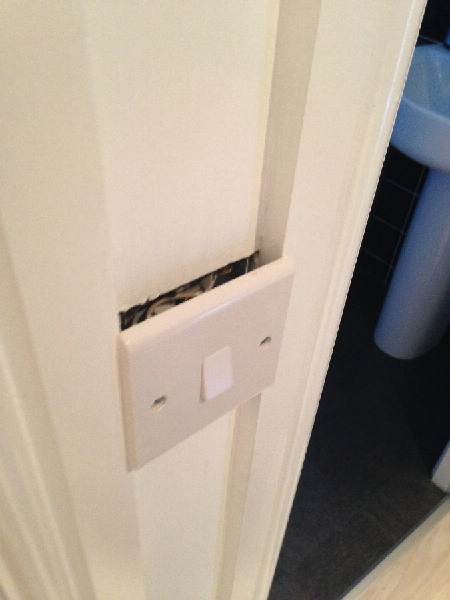
TW Snag Light SwitchThe quality of new homes is getting worse as housebuilders show contempt for their customers by refusing to tackle the issues in their poor quality, defect-ridden new homes.

This government has bent over backwards to help the house building industry, with taxpayer-funded subsidies such as the controversial Help to Buy equity scheme (£791million loaned for 19,394 new homes to 31 March 2014) and the ongoing relaxation of planning rules. So why are Britain’s housebuilders not doing anything to improve the dire quality of the new homes they are building?

The quality of new homes is getting worse as this recent article in the Daily Mail demonstrates; caused by a combination of a lack of skilled tradesmen, insufficient construction time, poor site management and the builder’s CEOs  only caring about profit and numbers (and their bonuses!) – quality doesn’t come first (if it ever did), in fact it doesn’t even come fourth!  To add insult to injury, housebuilders are even routinely refusing to take any action to fix defects that unlucky buyers discover in their new homes once the initial excitement wears off, coming up with “it’s within tolerance” and other excuses in an attempt to justify not fixing defects in their new homes.

Taylor Wimpey 9 months small size

Extensive remedial works still being done in a Taylor Wimpey new home nine months after moving in.

The sad fact is that the quality of new homes and many housebuilder’s reputations are now so bad, an increasing number of new home buyers are employing professional snagging inspectors to independently check for defects in their new homes before they move in. But yet again, housebuilders often refuse point blank to allow access to the new home for buyer’s inspectors until after legal completion, as a matter of “company policy”. This means that any issues identified cannot be fixed prior to occupation and even if the builder does attend to them later, (a big if!) it causes maximum inconvenience for the consumer taking time off work, moving furniture, mess etc.

Continue reading

Share this:
Share this page via Email Share this page via Stumble Upon Share this page via Digg this Share this page via Facebook Share this page via Twitter

Why the least expensive solicitor is never the best.

A recent report released by the Legal Ombudsman shows  a high rise in the number of complaints against solicitors – in particular against conveyancers.   One of the most serious issues that has grabbed the headlines were reports of solicitors not paying the stamp duty on behalf of their clients.   Whilst rare, this is  fraudulant.  HMRC, often many years later, are coming after homeowners for payment of the original stamp duty due with interest charges added on top.  

Deeds 2Of the 7,500 complaints received by legal ombudsman in the survey, around 18% were concerned with residential conveyancing.  It is thought that this due to a large extent, by the growth in the number of online conveyancers and so-called “tick-box, bucket shop style, call centre conveyancing services” often offering a conveyancing service for as little as £300.  

Buying a home is almost always likely to be the largest purchase most people will ever make. It is a legal transaction and buyers and sellers need professional and qualified legal representation.  Yet despite this, after looking at the other costs involved in moving home, many choose ‘cheap’ rather than ‘best’ when it comes to appointing a solicitor – a decision as the report highlights, many often deeply regret.   

It is always best to have a solicitor who is local to you so that when there are issues they can be discussed face to face.  They could be complex and if there is a problem you need a professional on your side to solve the problems on your behalf, not just part of a box ticking exercise.  You may find there are issues years later when you come to sell the house that were missed by the conveyancer when you bought.  

The advice is always to get a recommendations from people who have just bought or sold. Speak to them.  Then ask yourself: Does the solicitor sound competent? How well do they communicate?  Will they protect your interests? Feel free to negotiate on their fees but don’t skimp.   

Finally, if you are buying a newly built home, never, repeat never use the solicitor “recommended” or “suggested” by the house builder. They may claim it will be “quicker” and “easier” but you can be sure there will be a conflict of interest. In addition, under the Consumer Code for Home Builders, Requirement 2.5 states that house builders cannot restrict your choice of legal representation.

Share this:
Share this page via Email Share this page via Stumble Upon Share this page via Digg this Share this page via Facebook Share this page via Twitter

Is the Consumer Code for Home Builders fit for purpose?

After close examination of the recent Adjudication Scheme case histories, we ask……..Is the Consumer Code for Home Builders worth the paper it is written on?    The clue is in the name “For Home Builders” not for homebuyers.  At best, house builders tend to view the Code as voluntary or optional despite many of the Code requirements actually being required by consumer legislation.   At worst, as is shown by the published case summaries, house builders knowingly continue to disregard the Code requirements in the full and certain knowledge that the worst that could happen would be slap on the wrists and a small award against them.  Now in it’s fifth year, the Code is frequently referred to by the industry being used as an opportunity to promote new homes.

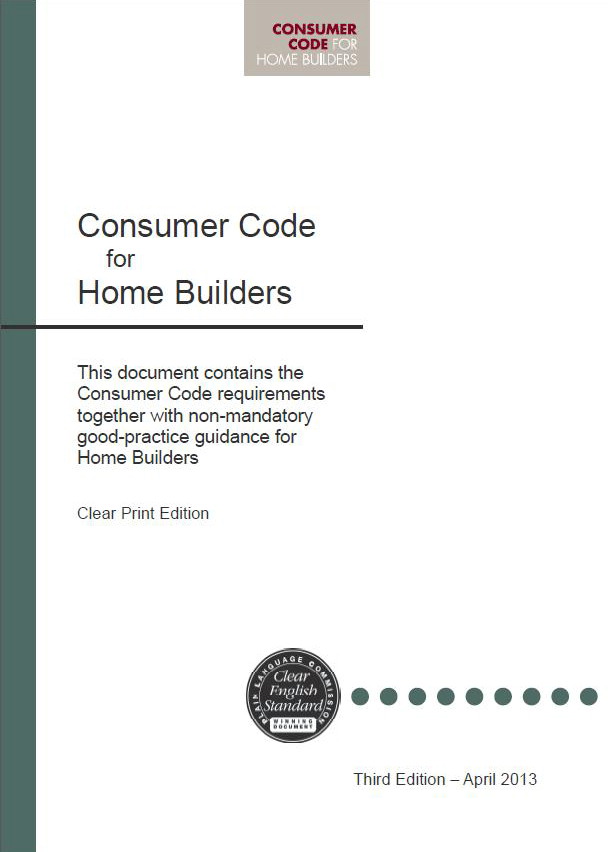
Consumer Code coverThe Consumer Code for Home Builders was launched in April 2010 apparently as a response to the Barker Review in 2004 and Office of Fair Trading – Market Study of Home Building in the UK published in October 2008. The Consumer Code is allegedly the house building industry’s response to the issues raised in those reports relating to customer service and satisfaction. It was created by a “group of stakeholders within the industry” who “joined forces to consider the issues raised” to “produce a Code of Conduct for home builders.” It was first launched in April 2010 – over FIVE YEARS after the deadline in Barker’s report!

CodeThe Code claims to:  “provide protection and rights to purchasers of new homes, ensuring that all new home buyers are treated fairly and are fully informed.”  But the protection already exists with The Consumer Protection from Unfair Trading Regulations 2008, making it a legal requirement to treat consumers fairly and The Business Protection from Misleading Marketing Regulations 2008 reinforces the legal requirement not to make misleading or false statements. The Consumer Code for Home Builders if strictly followed, should result in compliance with the legislation, probably the main reason it was created by the house building industry.

The Code applies to all house builders registered with the new home warranty providers such as the NHBC, LABC Warranty and Premier Guarantee.  It consists of 19 requirements and principles that house builders must adhere to in marketing, selling homes and their after-sales customer service.  Failure by a house builder to adhere to the code requirements can result in exclusion from all registers run by the warranty bodies that participate in the scheme. Has this ever happened?  Very unlikely!

But is the Consumer Code effective?  –  Do house builders strictly follow it?  –  Are punitive penalties being imposed on builders who are found to have deliberately breached the Code?   Going by the latest published Adjudication Case Summaries for 2013 it would appear not.

Continue reading

Share this:
Share this page via Email Share this page via Stumble Upon Share this page via Digg this Share this page via Facebook Share this page via Twitter

Pay row at Persimmon over Director’s share incentive plan

Jeff Fairburn 2sThe Daily Mail reported this week that three Persimmon directors are in line to receive a staggering £100 million pay windfall. This is part of a £400 million bonus pot linked to a long-term incentive plan equating to around 10% of Persimmon’s market value.

OLYMPUS DIGITAL CAMERATo qualify for the huge payout, Persimmon must give shareholders 620p in dividends between now and 2021. The rewards plan 2012 – around 30million shares in Persimmon, will pay out to several directors. Chief executive Jeff Fairburn, finance director Mike Killoran and southern regional director Nigel Greenaway all stand to share around £100 million. To qualify for the payment, Persimmon must pay certain dividend amounts by the end of 2015, 2017, 2019 and 2021. For 2015, the required amount is 170p. The firm has already declared dividends of 145p and has announced an intention to pay 95p in 2015. So job done for the first tranch of shares! If any biennial target is missed the scheme folds, although they will be able to keep any shares already secured from achieving earlier targets, but they will have to pay to get their shares. If all the targets are met by 2021, they get the shares for free.

Persimmon say the scheme was drawn up when the share price was 620p and that the directors would have to double the size of the company in ten years to benefit. A spokesman for Persimmon told the Daily Mail:

The analysis simply assumes that the share price in 2021 will be the same as it is today and ignores the challenge of returning £1.9billion to shareholders, while simultaneously growing the business to deliver an increase in the ex-dividend share price performance period of almost ten years……..This is a long term plan which is designed to drive outperformance through the housing cycle and there remains a very long way to go”

Continue reading

Share this:
Share this page via Email Share this page via Stumble Upon Share this page via Digg this Share this page via Facebook Share this page via Twitter

Taylor Wimpey threaten to take buyer to court over Help To Buy non-payment

After a a few problems and issues with his new home, despite the completion date being postponed by a month (6th December 2013), one unlucky buyer recently told us that Taylor Wimpey had constantly threatened him with legal proceedings on a daily basis. Amazingly Taylor Wimpey and both the respective solicitors allowed legal completion on his new home without the Help to Buy funding in place and later transferred to Taylor Wimpey – an underpayment shortfall of £44,000. 

Mr K told us:       “In the first week of January, we learned that our solicitor had not sent us the Help to Buy equity release form to sign. He played this down claiming it was a simple paperwork mix-up or oversight. Two days later, we received a call from Taylor Wimpey informing us that they are going to take us to court because for breach of contract as we have not provided the full funds on completion.”

Help To Buy jpg“It transpired that the Help to Buy money had not been released to Taylor Wimpey and they cannot take our solicitor to court, they can only take us to court. The lady from Taylor Wimpey said that even if they did get the balance of the money, we had still breached the terms of our mortgage and they were going to report this to our lender and the mortgage would be revoked.”

“Next we then get a call from the lady who deals with Help to Buy (Radian homes) who inform us that the mortgage offer is incorrectly worded and needs to be changed, otherwise they cannot release the money to Taylor Wimpey. Our solicitor insists the mortgage offer doesn’t need to be changed, Help to Buy insist it does and in the meantime, Taylor Wimpey continue to call us on a daily basis threatening to take us to court.”

“Both Taylor Wimpey and Help to Buy say that our solicitor is incompetent. Our solicitor then suggests that they are both partly to blame as well. We are considering appointing a professional negligence solicitor to take over the file with Taylor Wimpey saying that if we did, that they would take us to court straight away.” 

Continue reading

Share this:
Share this page via Email Share this page via Stumble Upon Share this page via Digg this Share this page via Facebook Share this page via Twitter